The problem
Low uptake of cervical screening among women in the poorest parts of West Lothian: women from ethnic minorities, women with disabilities, and women who don't speak English as a first language.
Case study · NHS National Services Scotland
About 30% of people in Scotland don't go to their screening appointments, and the poorer the area, the fewer go. In West Lothian I led research with the women least likely to attend, to find out what was in the way and what might help.
Low uptake of cervical screening among women in the poorest parts of West Lothian: women from ethnic minorities, women with disabilities, and women who don't speak English as a first language.
Planned and ran 40+ interviews, focus groups and workshops with those women, and made sure the research itself was accessible to them. Then co-designed and prototyped fixes with the team.
The first contact was the problem. A paper letter was hard to read, easy to lose and hard to act on, and booking or getting support to attend was harder still.
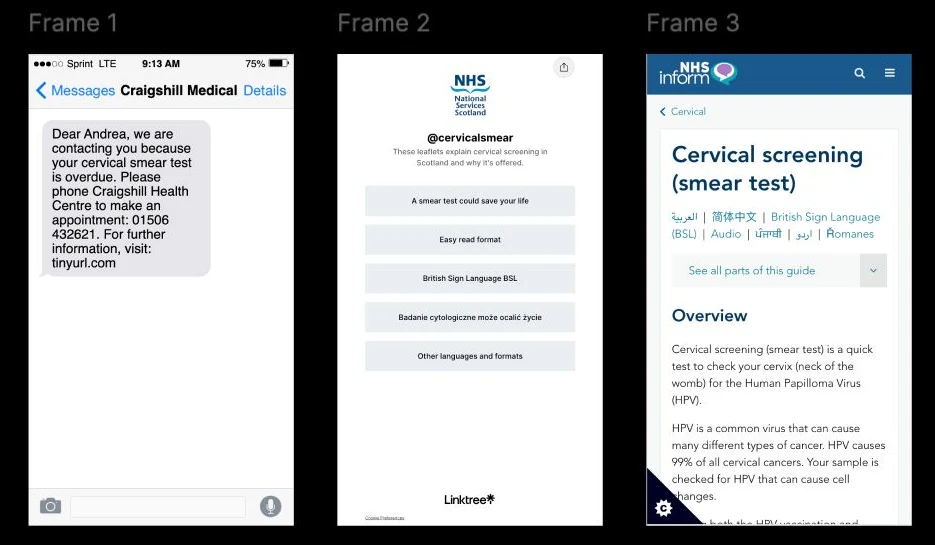
We co-designed a text-first invitation from your own GP practice. The work was nominated for an award at the NHS Scotland Event and written up as a playbook for other Health and Social Care Partnerships.
Working with the NSS Service Design Hub and the local Health and Social Care Partnership, we set out to answer one question: how might we use personalised communication to get more people in West Lothian to their cervical screening?
There are many reasons people don't go, such as pain, embarrassment, time and fear of the results. A service can't fix all of these. But it can change how people are invited.
The data showed a clear link between deprivation and missed appointments in West Lothian.
Including women with sight loss, for whom a printed letter is a barrier before anything else happens.
Including women for whom faith and culture shape how they feel about the test.
For whom an English-only invitation might as well not arrive.
We also heard from single mothers, for whom time and childcare were the real obstacles. Making the research accessible was a challenge in itself: interpreters, formats and venues all had to fit the people we wanted to hear from.
Pain or discomfort. Embarrassment. Time. Not being able to get an appointment. Fear of the results.
An easy way to book. Peace of mind. Wanting to prevent serious illness. Knowing the risk. Good, kind staff.
The top five reasons from published surveys of women about cervical screening. We used these alongside our own interviews.
“I think it's really frustrating the amount of post. Everything is online via text, and I think that's how most people like to work. If I get anything by mail, it goes in my log burning fire.”
“If I just got this and had no idea what it was, then I don't know if I would have bothered to do anything about it.”
Not going to screening isn't one behaviour. Based on Kathryn Robb's research at the University of Glasgow, we built a persona for each of four stages: unaware, unengaged, undecided, and decided not to act. Each needs something different.
“I don't understand what I'm being invited for.”
“Screening isn't relevant for me.”
“I'm scared what my results might be.”
“It's too embarrassing.”
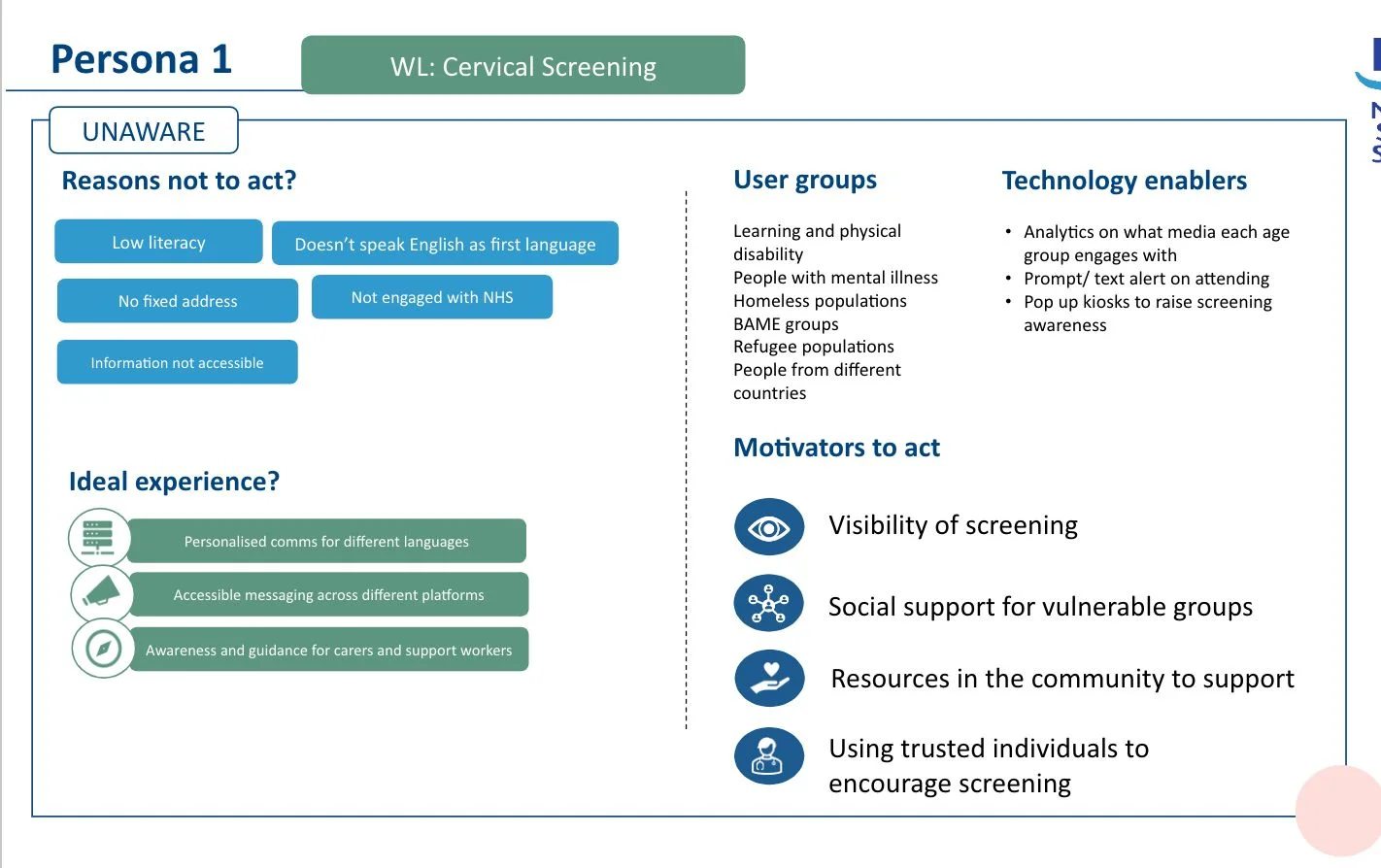
Ease of booking came top of what helps in the published research, and booking was one of the biggest barriers we heard about. So most of our ideas were about making the first step smaller. My behavioural design background helped here: how and when you ask people affects what they do.
The invitation arrives on your phone, from your own GP practice, with a number to call and a link to more.
The link opens easy read, British Sign Language, audio and other languages, so the invite works for whoever gets it.
Appointments offered by when you're free, with a way to ask for support to attend.
Reminder prompts by phone, so a missed letter no longer means a missed test.
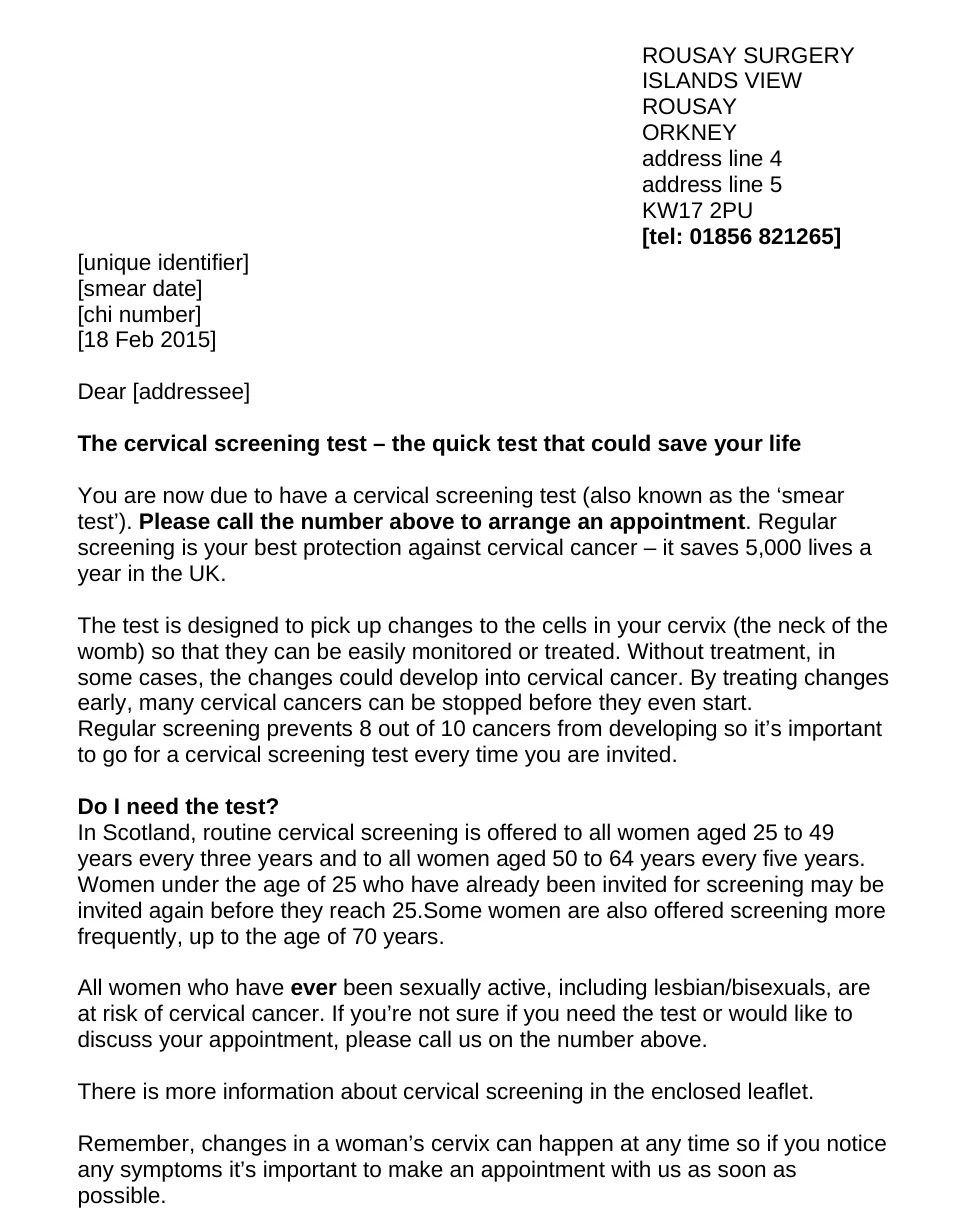
The work was nominated for an award at the NHS Scotland Event, where we presented it on this poster. The wider project also looked at bowel screening in North Lanarkshire, and the approach was written up as a playbook so other Health and Social Care Partnerships could use it.
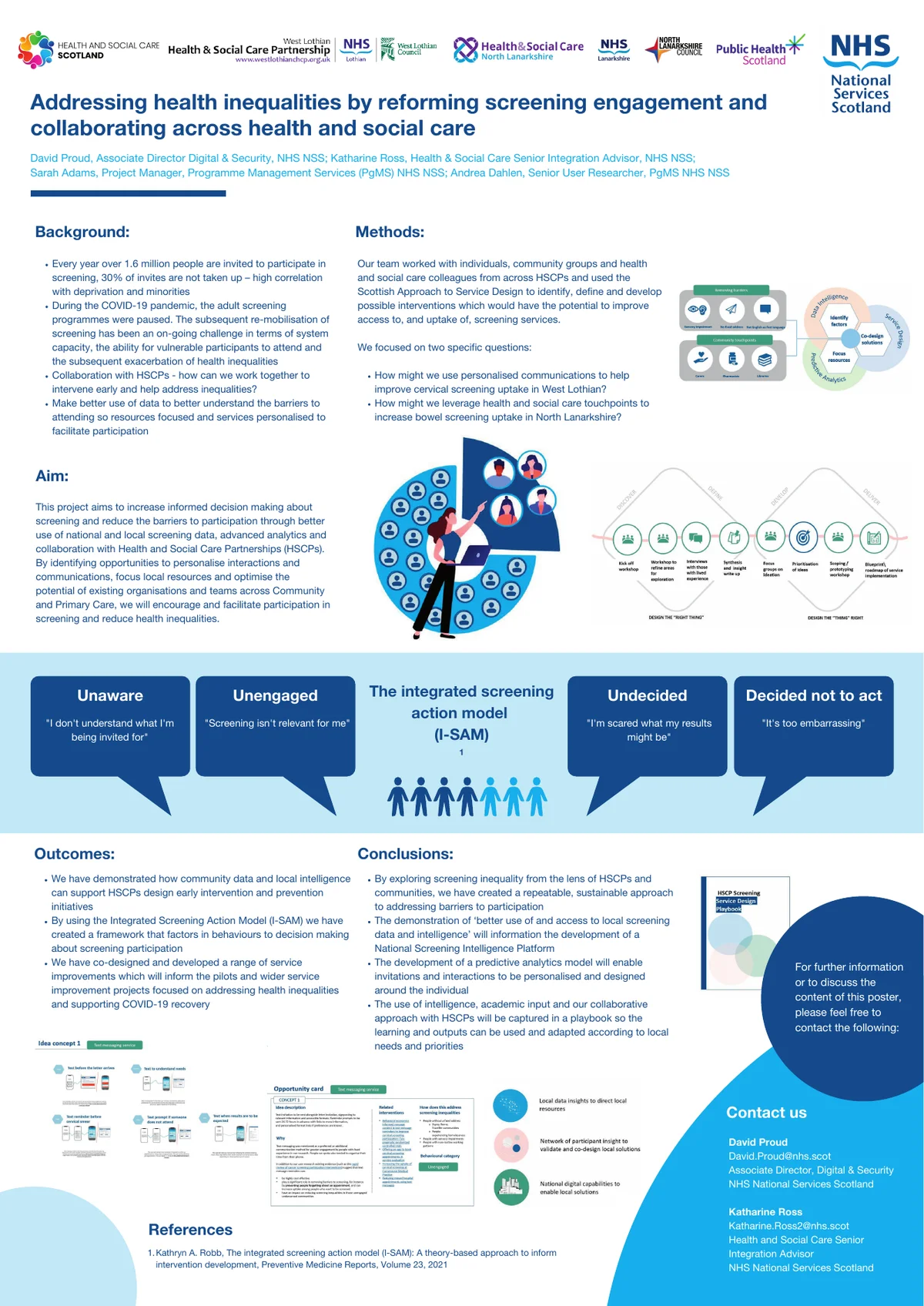
With David Proud, Katharine Ross and Sarah Adams at NHS National Services Scotland, the NSS Service Design Hub and West Lothian Health and Social Care Partnership.